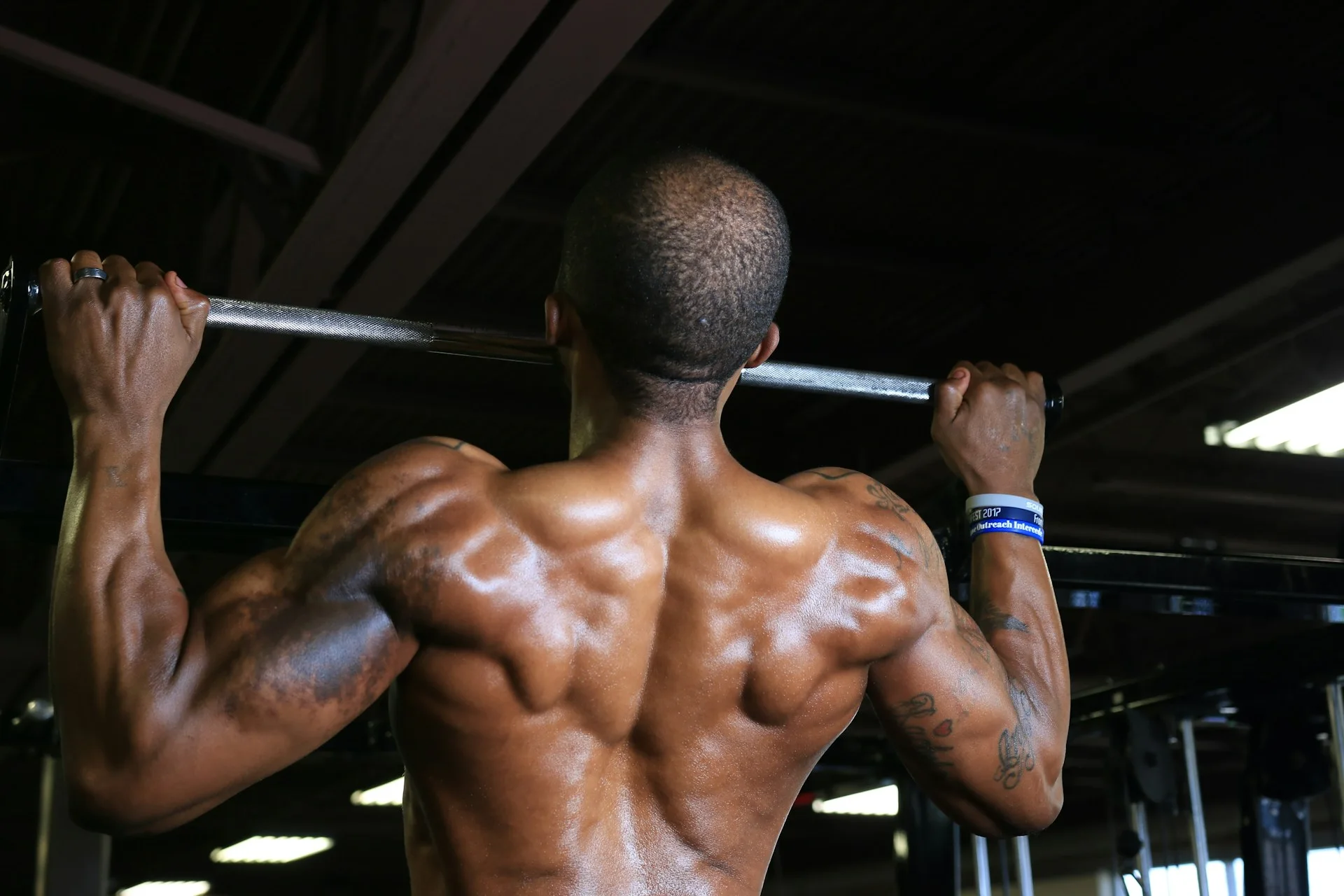
Learning to master the perfect pull up requires full commitment and consistent training. This exercise demands high levels of strength which when mastered, will act as a progression for other challenging calisthenics exercises like the muscle up.
But apart from the strength gains you will make, pull ups will define your back muscles much more than any other back exercise will, so it’s worth getting good at.
5 key steps to perform a pull up correctly
Step 1: Get a firm grip
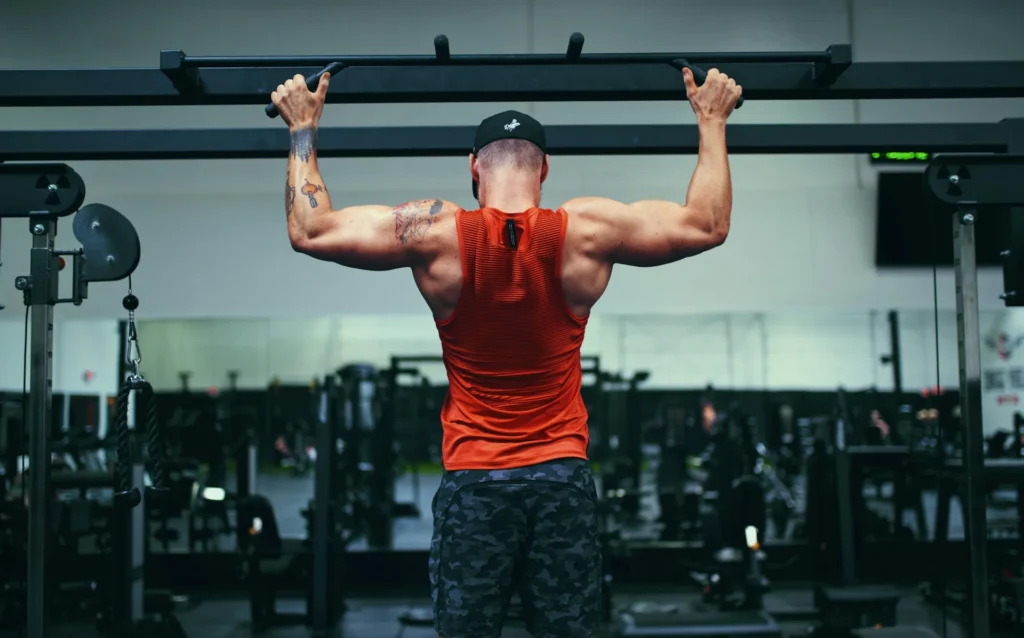
- Stand directly under the pull up bar with your feet slightly apart. Reach up and grip the bar slightly more than shoulder width apart with your palms facing away from you.
Step 2: Hang from bar with your core braced and your body straight
- Let your body hang from the bar with your shoulders locked out. Start engaging your core and maintain a straight body without swaying. This is your starting position.
Step 3: Bring your chest to the bar
- Start pulling your chest up until your eyes reach over the bar. It helps to picture yourself driving your elbows down into the ground. Following this step is crucial in order to fully activate each muscle group like your arms, shoulders and back.
Step 4: Extend arms until shoulders lock out
- It’s really important to lock out your shoulders in the final phase of the movement before beginning your next repetition. By getting a full range of motion, you are challenging your muscles’ ability to exert force at its weakest point, allowing for greater strength adaptations.
Step 5: Repeat
- From this point on, start repping them out! If you’re performing pull ups correctly for the first time, you will probably struggle to get a high number of repetitions. However, repeating each one with good control, complete muscle activation and full ROM will help build your pull strength and endurance quickly.
The 4 Most Common Mistakes
Pull ups can be a challenging calisthenics back exercise, but it becomes much more difficult when you don’t perform it with the correct technique.
So, it’s important to point out the areas where people usually go wrong so that you can begin training more effectively.
Mistake #1: Not extending arms completely during eccentric movement
- The most common mistake people make is not fully extending their arms at the bottom of the movement. When you don’t use a full ROM, you’re limiting yourself of all the strength and muscle-building benefits that pull ups can provide. To counter this, always make sure your arms are fully extended before you start your next rep. This allows for greater muscle fibre recruitment and activation. It also strengthens the shoulder joint, causing an increase in shoulder mobility and better posture.
Mistake #2: Swinging pull ups
- Another big error people seem to make is using a swinging motion to try and perform as many repetitions as possible. This is not how you should approach doing pull ups. While this technique might allow you to rep out your pull ups, it does not engage the right muscle groups enough and can potentially cause injury to your back muscles or even other muscles that are overcompensating as a result of that movement. Keeping your core engaged and body straight is the most effective technique to increase your pull strength.
Mistake #3: Not engaging the core
- The 3rd most common mistake is neglecting core activation during the entire movement. The reason we need an activated core during the movement is to stabilise the body and distribute power evenly. Doing so will also ensure that every relevant muscle group is activated and playing its role. A braced core will add intensity to the exercise and result in greater strength gains.
Mistake #4: Fast tempo when returning to starting position
- You must always remember that exercise is about quality, not quantity. If you are performing each rep quickly to try and reach a certain number, you are not doing yourself any favours. To get the most benefits out of a pull up, you need to focus on slow and controlled movements specifically on the eccentric phase (extension). Performing your reps with controlled and deliberate movements will ensure you’re getting an optimal amount of muscle activation.
Pull up Progression Exercises
Dead Hang
-
- To start building the strength and technique to perform a pull up, start with foundational exercises like a dead hang. Hanging off the bar helps to build grip strength and shoulder stability, important factors of a perfect pull up. A dead hang also stretches and decompresses your spine, relieving tension, tightness and improving posture.
Negative Pull Up
-
- This movement focuses on the eccentric phase, where you begin lowering yourself back to your starting position. A slow and controlled negative pull up puts your active muscles under more stress, causing greater strength adaptations.
Assisted Pull Up
-
- Another great way of building strength for a pull up is to make the load lighter. 2 great methods of doing this are assisted pull up machines, or resistance bands. They can both be used as an adjustable level of support. Assisted pull up machines allow you to adjust the weight you’re lifting, while resistance bands use tension to assist with part of your body weight.
Gradually Increase the Intensity
Like most exercises, learning how to do a perfect pull up won’t happen overnight. In the early stages, you will most likely struggle to perform one rep just like I did. However, the key to coming out on top is to embrace your failures as learning curves and remain resilient.
Once you figure out the technique, it’s only a matter of increasing the exercise intensity to see gradual strength adaptations. Start by adding 1 repetition to your set every week. Once you are doing a solid amount of repetitions in the range of 10 – 15, you can begin adding extra sets or, if you really want to add intensity, start performing weighted pull ups with a weight belt. These are the best ways to progressively overload the pull up exercise.
Equipment You Could Use
Chalk
-
- Chalk is a very common tool used for pull ups and various other strength exercises as it acts as a drying agent which absorbs sweat in your hands and increases friction with the bar, ultimately enhancing your grip. This leads to various performance enhancing effects including increased repetitions, ability to handle more weight and reduced formations of calluses and tears in the hands.
Resistance Bands
-
- Another piece of equipment that can enhance your pull up training are long resistance bands. They help to eliminate some of the body weight being lifted, making the exercise execution that little bit easier. This is perfect for those still learning pull ups as it allows them to focus on perfecting the technique of the movement.
Portable Pull Up Bar
-
- This is a great option for those who prefer doing pull ups at home or on the go. These pull up bars are typically designed to fit perfectly in a doorway, making it fairly easy to install and remove. They come in various styles including adjustable frame width bars or mountable bars. But use it with caution and make sure that you install it correctly to avoid injuring yourself or even breaking your door.